Things I would differently if I did flight school again

I recently posted a 'Hot Topic Tuesday' to my Instagram and TikTok talking about the things I would do differently if I had a redo at flight school. If you want to watch the original video click here to visit my Instagram and see the video. This is a continuation of the main points I made in that video along with explanations as to why I made those points. If you happen to be making a decision about flying school maybe some of these points will help you out, as a PSA these are individual reasons to myself and I'm aware that this won't be everyone's story.

Ok so with that out the way and with reference to my video, the first point I made was that I would choose modular over integrated. For anyone not up to speed, I am currently on the integrated programme with Leading Edge Aviation. At the time of deciding I was mainly considering the ground school aspect of training as I knew that would be the hardest part for me. I didn't realise that flying schools offer the ground school programme just the same as the integrated programme. This means that in my class there were students on the modular programme, so they complete ground school with us and then they go off and do the flying separately on their own. Had I realised this at the time I would have chosen to do this, my main worry was if I had to complete ground school on my own it would never get completed because I need the discipline of a school setting. To further add to this I find the environment of flight school in general quite competitive, which for me was not helpful. I constantly felt behind and not clever enough to be in the same rooms. I find it hard to enjoy where I am at currently because it is always 'whats the next thing' and its hard not to get wrapped up in that mindset, especially when everyone around you is progressing. This is another reason going modular would have been more beneficial for me,I don't always do my best in a competitive environment and equally being surrounded by people all doing the same thing; it can be helpful to discuss trials and tribulations, but its also tiring to be around the same type of people. I really enjoy talking to different people in different jobs and finding out about what they do.

Of course a massive reason people choose modular is the 'affordability' of it. You can work whilst training as it isn't a full time course. This is another reason I would choose this route. I didn't realise how not working would be so hard. I know how ridiculous that sounds but as someone who loved their job I find it very hard to sit still and just be in Spain for flying. Considering the lack of flying in Spain at the moment its hard to have no other purpose. I would love to get a part time job to give me something to do and to have other people to talk to.

Something else I mentioned in my video was to go out a bit more often. During ground school I only went out probably at most a handful of times. I thought that if I went out on Friday night I would be missing out on a night of revision, plus the next day if I got drunk! Looking back now a night out every so often would have been good for me, to get out of the stressful environment, and also a mini reset at the end of the week. I always saw it as a 'waste of a night of revision' however I think it would have meant that the other 6 days of revision would have been more productive. Towards the end of ground school I really burnt myself out, revising constantly and it made me really hate it. I did not enjoy the ground school experience and I think this was a big reason why. I didn't socialise much outside of the academy and I was just trying to survive everyday. My best advice as someone who struggled through ground school would be to take a night off every now and then. You will probably thank yourself for it because you will be more locked in to the work.

In the same vein as the point above would be to visit home more frequently than I did. During my 6 months in Oxford I think I went home 4 times. I didn't want to go home because I wouldn't do any productive revision, however in hindsight it would have been good to get out of the ground school bubble that is so consuming. Even just to see my home friends for a day would have been better than nothing, but again, I was so worried that I was missing out on valuable revision time. Also on this point; I felt really guilty for doing anything other than revising, to the point that even though I was not doing the most productive revision I would still sit at my laptop for hours. Unfortunately the act of revising only works if you are actually covering topics you need to work on, not just doing the same easy questions over and over :/

Other than that integrated has been good, its an easy option due to the fact that I don't have to sort out my own training plan. Of course I am in the privledged position that I can afford this course, however let this be a sign to you that just because it is more expensive it doesn't mean its automatically better. It is definietly the more convienient option, but for me the environment was not the most conducive to feeling successful throughout each step.
Fact vs Fiction Staff Travel Edition

My last Instagram reel was based on the misconceptions of staff travel. I realised there is a lot of information that it can get confusing, and it is also company dependent with what benefits you will actually receive. However let this be your general guide to what staff travel is and how it works, along with some of the benefits I received working at Virgin Atlantic.

If you haven't gone over to my Instagram already, let this be a sign to check it out to see short form content on my time as cabin crew and now as a student pilot!

Ok so... lets start at the beginning. What is staff travel? This is a benefit that you will receive when you work for an airline. It allows you to travel at a discounted rate with the airline you work for as well as with alliance airlines. As an example at Virgin I was able to travel with Delta Airlines as they own 49% of the company. On top of this we got discounts with Virgin Voyages and all the other Virgin companies. Staff Travel is a big reason people will work for an airline as you don't have to fly for the company to get the benefits. You can work in the office or as ground staff to still have access to these discounts, the only difference will be seniority.

How does staff travel work? This will be dependent on your airline, however as an overview you will get access to a booking system through your airline. Through this system you will be able to select destinations and book tickets. Its very similar to how you would normally book a flight, the main difference is you won't be selecting a seat as this gets allocated on the day of travel. When you make a booking you will be able to see how busy the flight is based on how many seats are booked. This is helpful because it gives an indication as to whether you will get a seat on that flight. My best advice if this is your first time using staff travel is to book a destination with multiple flights servicing this destination, for example; Virgin have 2 flights per day from LHR to LAX, this means that if you book yourself onto the first flight and its fully booked you will be rolled onto the second flight and so your chances of getting to LAX the same day are better than if there was only one flight per day, I hope that makes sense!

To break down the pricing slightly; a misconception I mentioned in my Instagram reel was that staff travel is 'free'. It isn't free, it is heavily discounted so as an example, when I booked a ticket from LHR to LAX the total price was roughly £500 return for one person. As a comparison on the Virgin website a return for one person to LAX is about £850. As you can see the ticket is not necessarily cheap. The only way this is made 'cheaper' is if you are upgraded to premium or upper class. In this case £500 is really not a lot.

It becomes more complicated when you want to use your benefits with a partner airline, similar to what I did booking a flight with Delta Airlines. I had to use a seperate website which was like a third party app to book tickets. I only used this once and to be honest I wasn't sure I did it correctly so I really thought I would get to the gate and be denied boarding. Thankfully this wasn't the case and it turned out to be a really nice flight. When booking through staff travel all the staff on the flight and on the ground will be aware you are a staff passenger due to your name having *staff* under it. When I travelled with Delta this definietly added to my experience because I was moved into a more legroom seat and had a couple of freebies thrown in like a glass of prosecco.It truly is the little things that make the most difference.

I would say the thing most people assume with staff travel is getting a first class seat or a really nice seat on the plane due to being staff. Seating is based on seniority and position in the company. As an example if you are an on board manager and you have worked in the company 20 years, you will be quite senior on the staff travel list. However if you are a captain you will outrank this manager due to job title. If you want to see two adults arguing just book a staff travel ticket because honestly the seating can create so many issues, especially if there are only 2 seats left on the plane and 5 people are standing by for that flight. In my personal experience with staff travel the worst it has been for me was sitting on a jumpseat, which is a seat the crew sit on for takeoff and landing by the door. Sitting on a jumpseat for hours by a flipping cold door is not for the weak, its uncomfortable and noisy, oh and you technically don't have food allocated for you as a jumpseat is not part of the passenger numbers, so you also have to hope some passengers don't want to eat, so you can eat their food! Before you start going on about 'oh the ticket was cheap' yes, it wasn't expensive compared to a full fare seat, however that is never a fun time. Until you have done it you can't understand the misery of a jumpseat x

On the flip side of this is getting a business class or first class seat. Staff travel can be the worst or best thing, it really depends. I have seen both sides of it, and let me not sit here and pretend I haven't flown around the world in business class with the opportunity to see the world because of this benefit. It is without a doubt the only way I have done so much travelling, as much as I dislike economy I hate a jumpseat, so I will take an economy seat any day over this.

On that note let me give you an overview of the benefits of Virgin Atlantic staff travel. If there are seats in upper class available the crew will move the staff passengers into these seats based on seniority. If you're not sure as to whether this is a 'benefit' or not, at British Airways they tend to not do this on a flight:/. When I used my staff travel I never had a problem getting on the flight, even if it was economy I still got on the flight. Virgin also allowed us as staff to use the clubhouse at Heathrow which is their upper class lounge area, this is a really lovely perk because some airlines will say point blank 'no' but with Virgin if the lounge isn't too busy you are able to use it, even if your seat is in economy.

Regardless of my seat on the plane or how much I despise economy I will always be grateful for a seat on an aircraft. I would never have been to half the places if it wasn't for staff travel

6 weeks to the skies: What training was like

What was my training process like and how intense was it to learn everything in under 6 weeks? I will share my training experience and everything I learnt as well as the things I didn't :/

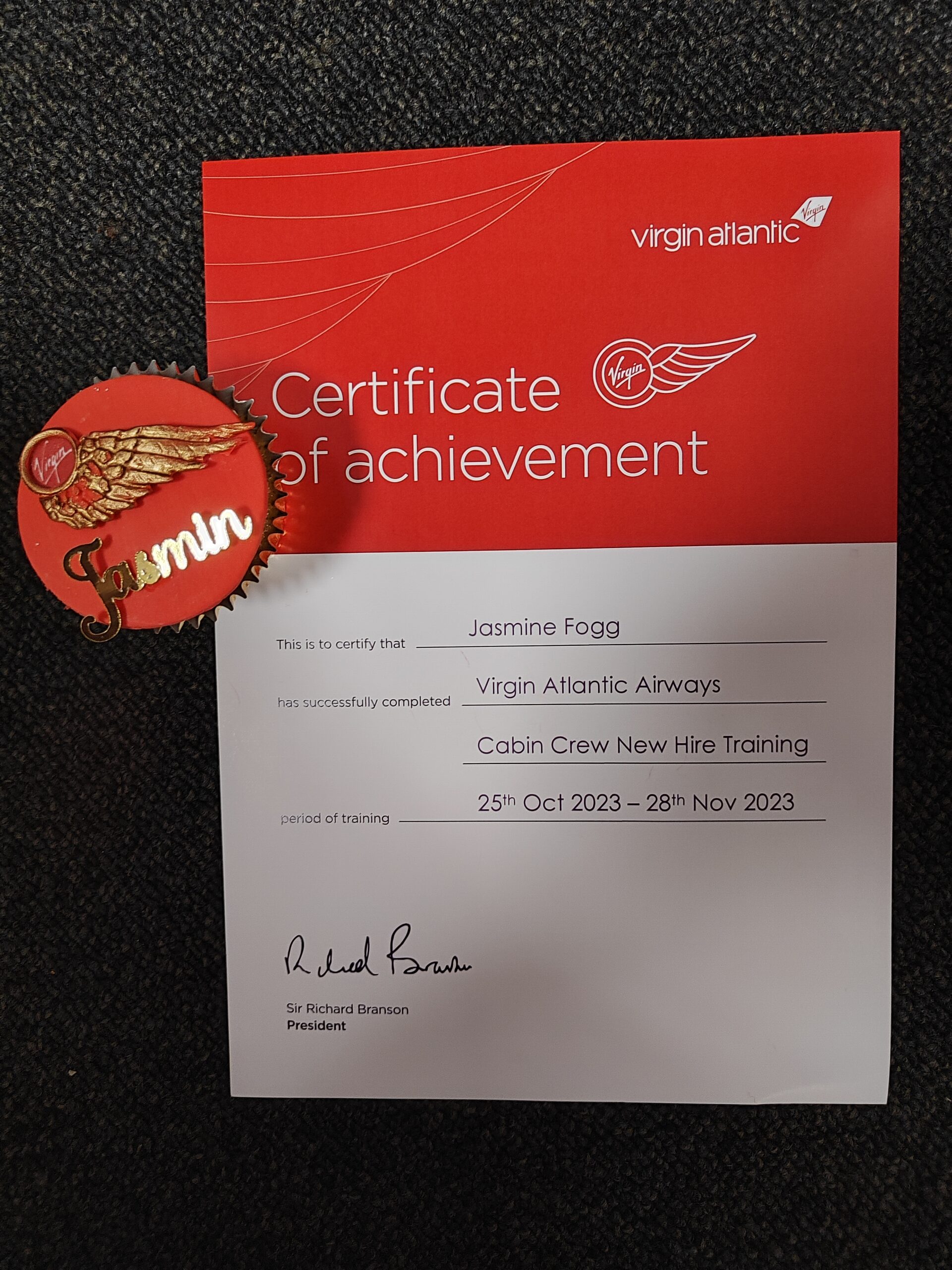
My first day of training started on 25th October 2023, I was part of Virgin training group 939. Virgin Atlantic training centre is inside the CAE academy, and so I turned up in my smart casual dress code with my hair in a bun and makeup done. From what I recall the hair being tied up was mandatory due to safety, however makeup was never mandatory. Uniform was only worn on the last 3 days of training for the service and wings ceremony, so I absolutely couldn't wait for this day!

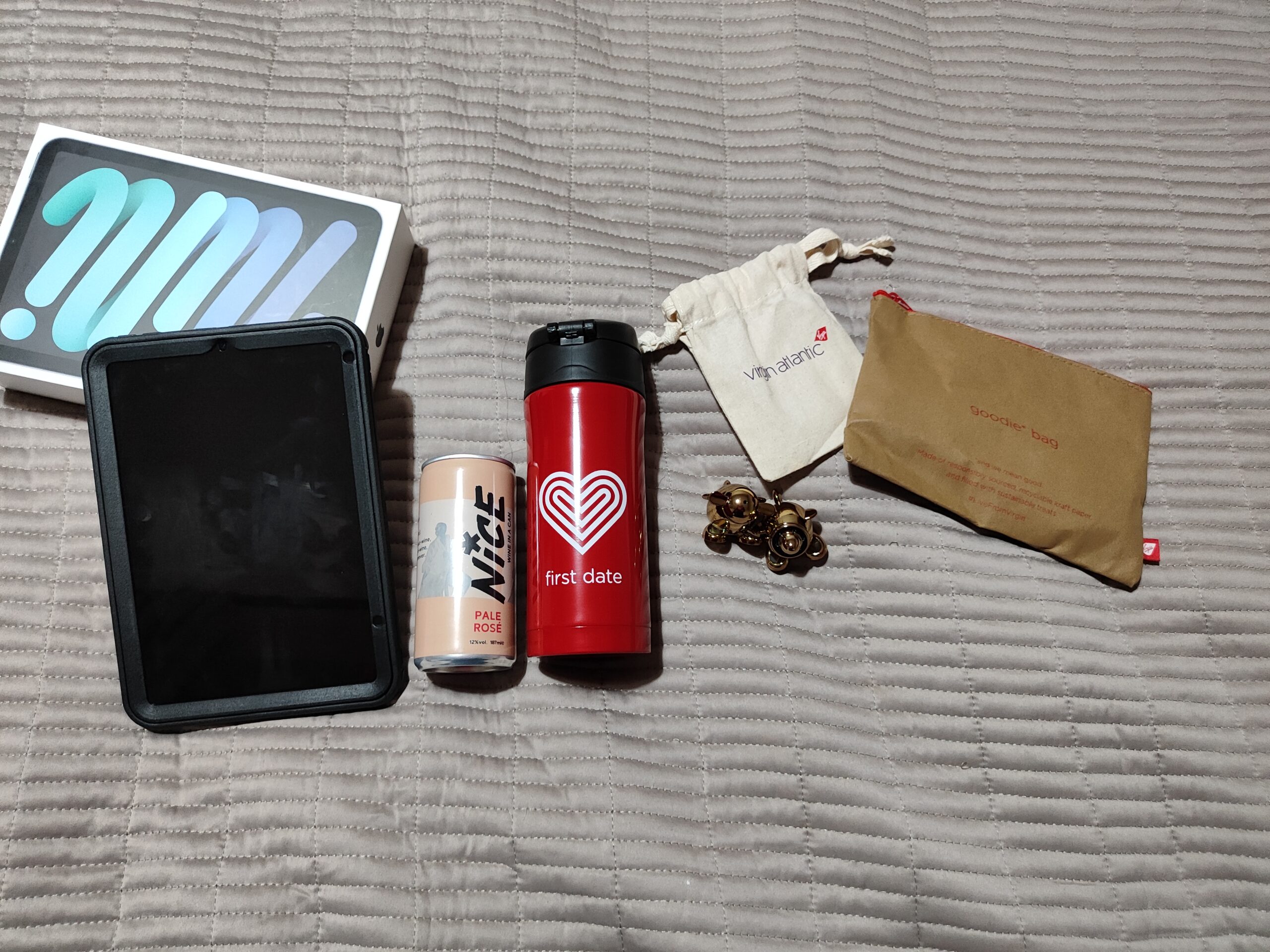
Day 1 was all about getting to know each other and how the training course will be run, as well as some group exercises. We also were provided with an ipad and a few goodies as a welcome to Virgin. I remember day 1 was very exciting and getting to know the other people in my training course; I've never met a group of people where we all *for the most part* got on and where all similar in the best way. It was so refreshing to be in a room with likeminded people, and everyone was open to getting to know each other. It was a lovely place to be

Day 2 was when the proper work started. We had about 1 week of learning Airbus which encompassed the A330-300, A330-900Neo and A350. Each day we covered a different area about these aircrafts. It was super confusing at first though because they are all really different, even down to how the safety cards look on each plane. I was revising every night just to make sure I had covered everything and understood the differences between them. Even though they are all Airbus, the doors are different, the safety cards are different, the layout of each plane is different... 

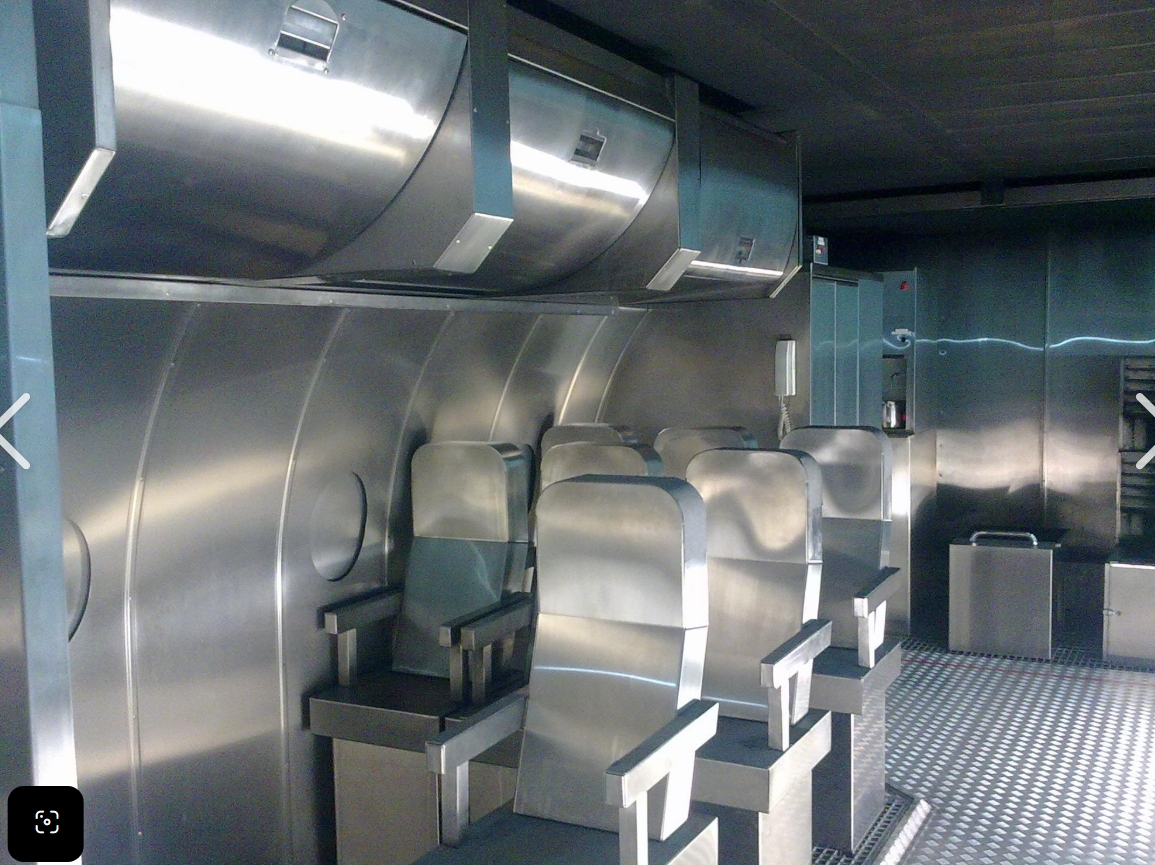
We also went to the rig where there are all the different doors and where we simulate emergency scenarios such as a ditching, which is a landing on water. The rigs were stressful because we had to know the commands and how to open the doors correctly as well as how to sit for an emergency. I don't think anyone enjoys the rigs because its were we get tested and they can give us any scenario on the spot. I think the one I hated the most was a cabin decompression because depending on where I was sitting would mean I had something different to do and it just wasn't a good time haha. As well as this we had a multiple choice test to complete on our ipads for the whole of the Airbus chapter. This wasn't easy because I got confused with each plane and for example what symbol is on what safety card. Luckily we were able to retake the test twice should we need to.

We also had a few days of AVMED training which is aviation medicine training. It is effectively life saving training and involved things like CPR, basic intubation, heart attack treatment and burns, to name a few. Avmed covered lots of different situations we could find ourselves in whilst on an aircraft, and over the ocean where the closest place to land could be a few hours away, learning how to manage conditions was a big part of it considering the factors. We also had to learn how a medical emergency is handled and the correct steps to take, such as who to inform and who manages what. It is the same for dealing with a fire onboard, learning who controls what is super important in ensuring the fire or medical is managed effectively and with minimal disturbance to the passengers. We had to do an exam in Avmed towards the end of training which was to test everything we had learnt. We did a practical exam as well as a multiple choice test on our ipads. 

Week 2 was covering Boeing which thank God was just the 787-9. No complications just one plane. Although saying that the whole plane is different, the doors are operated differently, the life jackets are different to put on, the window 'blinds' are non-existant and the onboard systems are all called different names. The exam for Boeing wasn't too hard purely because it was based on one aircraft however going forward when I was rostered on a Boeing for a while and then an Airbus I definitely had to refresh myself on the procedures. 

As well as this we also went on an day trip to the Gatwick K2 swimming centre. This day was lowkey fun but I also hated getting up so early and knowing my hair was gonna be wet. We had to do a swimming assessment to make sure we could swim unaided across the pool fully clothed. In addition to this we put on life jackets and had to form a circle in the water which is what we would do in the event of a ditching. We each had to then climb into a life raft with the life jacket on. This was probably the hardest bit because the strength needed to pull yourself up a little rope ladder dangling in the water was really difficult. We all managed to do it though so it was a good day. I would say a lot of people stress about the swimming test but it really wasn't too bad. Its honestly a lot of fun and everyone encourages each other so if anything it was a great team building exercise. *To see photos of the swimming test click here to visit my Instagram*

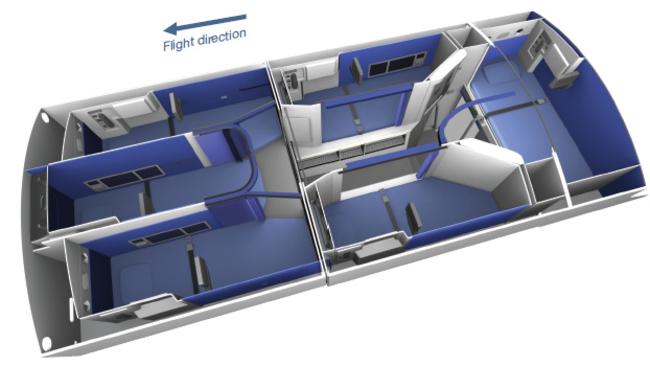
Probably the best day was when we actually went on a day trip to Heathrow Airport to see the aircrafts and go onboard. I loved this day because everything we were learning about we were able to see in person, and it helped but certain things into vision. Such as the crew rest compartments, these are so confusing to try and explain, so being able to see it was wayyyyy easier to understand. For images of crew rest go over to my Instagram where I did a whole post about this topic. This was also a fun day because I had never been onboard a Virgin Atlantic aircraft before and so to see it close up and to be able to walk around and get a bit familiar was amazing.

We also had a segment of fire training which was completed in the fire rig. Its basically a metal container with a glass wall, and uses gas which gets turned on to put the fire into different places, such as an overhead locker, an oven or the seat. We had to simulate putting it out using water inside a fire extinguisher. We also had to wear a smoke hood which was a god awful thing to put on and take off. We of course had a multiple choice test on fire as well as dangerous goods to make sure we had the knowledge around these subjects.

The last part of our training was 3 days of service training. I would say more of a crash course in service training, because 3 days wasn't enough to understand what the actual job was. Its funny because the day to day of cabin crew is all focused on service and what to do and yet we only got 3 days on this. Of course it makes sense the majority of training was focused on safety, however a couple more days of service would have been much appreciated. I found this portion of the course to be not the useful honestly. From knowing what I know now, each flight is done a bit differently because each manager has a different way of doing things or they have found ways of doing things that works better. The service training was teaching us about the 'correct' way to do things, not necessarily the easiest, or quickest way. The bit I enjoyed the most was wearing our uniforms because this was the first time we had worn them and we were seeing each other in them, so I was excited purely for that. I remember having so much imposter syndrome walking into the training school with my uniform on, it was bizarre but I felt amazing. During these last couple of days we also were given our first rosters, for the month of December 2023. This day was super exciting, finding out where our flights would be and it became so real at this point. I still remember my first roster; JFK, LAX, TPA, JFK. I had never been to JFK before so I was overwhelmed with excitement. It was such a cool day and suddenly felt very real that I really was cabin crew for Virgin Atlantic!

 Our very last day in the training school was our 'wings day' where we got given our wings to wear on the uniform which symbolises qualified cabin crew. We got to take photos in our uniform and celebrate with some prosecco. As a group we all went out for one last dinner because this would be the last time we were all together as a few weeks later we would all be off on trips. A crazy concept, but wow was I excited. To find out more about my first trip to New York click here!


Things I wish I knew before starting flight school

This will be a more personal post that reflects the things I wish I knew before starting. You may not agree with some or any of the points I make and thats ok, everyone's story is different and everyone has their own perspective looking back. 

Ok so now I have addressed this; onto the things I wish someone would have told me before embarking on this chapter of life. My first thing is that comparison will be the death of you. Truly this is something that I still have a hard time with now, but during ground school I think this would have been the reason I would have given up and left. I always felt like the person who knew nothing, after a lesson we would all go into the communal space to grab a drink and people would be talking about what was just covered and I wanted to be anywhere else but that room. I could never add anything to those conversations because everyone seemed like they knew so much more than me. I eventually took myself out of these situations and stopped engaging with it because it made me feel really crappy. Looking back now my best advice for you would be to trust in yourself that you know what is going on. Just because everyone else is testing eachother or discussing certain things it doesn't mean you need to get involved, but it also doesn't mean you don't know anything. I often felt like I didn't belong in those spaces and it was something I had to tell myself that we all went through the same interview process and that I belong in this space just as much as everyone else.

On this point my next piece of advice for you would be to make a solid couple of friends. During my groundschool experience I had about 5 different friends from my class. It turns out for one reason or another this became a toxic environment, which I am no longer involved in. However I would say now, having just a couple of really good friends is so much better than being part of a gossipy big group. During a setting like ground school this is hard because you will see the same people everyday and you are in close quarters with the same people, so you may feel its easier to just go along with what everyone else is doing. I'm not going to say to isolate yourself and not join in but just be aware, that sometimes those groups of people don't have the best intentions and they get through by rumours and gossip. Personally for me if they are talking about others they will be speaking about me in the same way.

I know I can't be the only one who feels like I knew nothing leaving the classroom after a full day of learning. So often I would go back to my accomodation and feel like WTH did I learn today. Again, trust yourself that you did absorb some things. That is a good starting point and you do know bits and pieces. I felt really overwhelmed with feeling like I knew nothing. I'll be the first to tell you that I'm sitting in Spain with all 13 exams passed so I clearly knew something! I felt like I stressed myself out because I was so fixated on 'not knowing anything', honestly that took so much of my brain power for no reason. If you are sitting in this feeling I would say to not worry about this too much (I know this is easier said than done). I would answer practise questions which helped me actually see that I have learnt something and I'm not completely useless x

One thing I wish I had done a bit more of was take a few hours away from revising everyday. I very rarely took time out and its because I am slower to pick up new concepts so I would be going over things a lot more and in more detail to understand it. However I feel like in the long run I burnt myself out. I will say that a major reason for not taking time away was because I felt really guilty for not revising. I knew I had so much work to do that if I wasn't sitting at my desk studying I was wasting time. I feel a lot of people can share in this feeling and it was why I rarely did anything after a day of ground school lessons. Hindsight is a great thing and I think I should have definietly taken a friday night off to chill and relax a bit. I ended up really hating my time in groundschool and I think this is a big reason why.

The last thing I wish someone told me is to just think of the next day. Not the big picture. I understand this will be different for everyone and some people need to see the end goal to feel like what they are doing is worth something. However I honestly didn't think I would make it to Spain because I struggled with ground school and I felt like I was waiting for the other shoe to drop and for something to happen meaning I failed something, and wasn't going to Spain. For this reason I never thought about 'life in Spain' or the flying phase; 1. this stage feels so far away in the midst of ground school and 2. I coudn't see any further ahead than tomorrow or the next day. Anytime someone spoke about Spain I would not pay any attention because it just didn't apply to me, and I didn't want to think about that stage when I was so far from it. I remember when I passed all my exams and I was actually getting my visa for Spain, it fully looked like someone had just sprung this idea of Spain onto me. I couldn't believe it was actually happening until I was on the flight out, because I kept thinking something would happen or they would realise I hadn't passed all my exams. Some delusional thought like that. Jumpscare to me. I made it to Spain, haha.

Secrets of being Cabin Crew

This was another highly requested topic, as voted for on my Instagram. The behind the scenes, things passengers don't see and even guidelines that you may not know exist but could get you offloaded on a flight.

The Crew Rest Area

Starting off strong is the crew rest areas, I mentioned about this on a previous post but crew rest is an area that passengers rarely/never see. On the majority of planes I flew on the crew rest area was above the passenger cabin, basically in the overhead lockers right at the back of the aircraft. Most people don't even know it exists; if you time it right as a passenger and hang around in the economy galley you might see the crew come out of a door into the galley half way through the flight. That will be the crew rest area. I used to love the bunks, so cosy and small. Especially with light turbulence, I found it so relaxing. The photo below is of the A350 crew rest. This whole compartment is accessed through a door in the economy galley and lives in the overhead locker of the middle back rows of economy. The bunk that spans the width of the crew rest at the bottom is the bunk above the door to enter and exit. As you can see it is very compact and cosy. As you can see there are 6 bunks, so half the crew go on rest and the other half stay in the cabin monitoring. In each crew rest bunk is an oxygen mask, seatbelt and light, very similar to the overhead panel in economy. Each bunk also has a curtain around it for privacy and we got provided with linen and if your lucky a duvet and pillow:) 

Noticing the small things

Something else passengers might not know is that if cabin crew sense a person is already too drunk on boarding they can refuse that passenger to board. Most people don't realise this is a policy on airlines, however if you are in the airport having alcoholic drinks before a flight its best not to go overboard, if you get to the door of the aircraft and the crew sense a passenger has had too much already they can either refuse to carry that passenger or reduce/ not serve them alcohol for the duration of the flight. This has happened to me once where I was at the boarding door of the aircraft and a passenger came on very drunk, I mean I could smell the alcohol on him. He was travelling in upper class (Virgin's business class cabin) so it wasn't easy to talk to him because 1. he paid a lot for his seat but 2. he was drunk and you can't reason with drunk people. Anyway my manager offloaded him after discussing with the captain because he was going to create us so much more work and would probably argue with us when we would deny him alcohol. On the theme of alcohol it is also the crews responsibility to monitor alcohol intake during the flight. This is kind of impossible with the number of passengers however if a crew member notices any particular passengers that keep asking for more to drink or they seem to be drinking quickly, we can either say the bar is closed so they can't drink anymore or we can water down the drink to add more mixer and less liquor, or more ice. There is always a solution, because no one wants to sit around a drunk person or deal with them.

 Safety Silence

 As a passenger have you ever sat at an exit row opposite a crew member and noticed they stop chatting and sit in silence during take off?

Something subtle that most passengers don't realise is that during take off the cabin crew are silently reviewing emergency procedures and commands. One of my favourite positions to work was in the middle of the aircraft at the 3rd exit door of the aircraft. This position was also where I sat for take off and landing and was directly opposite passengers sitting in the exit row of economy. When I would sit down for take off sometimes it was nice to have a chat with the passengers opposite me and find out why they were travelling to whichever destination we were going. On Virgin specifically just as we would line up for take off we would hear a 'double ding' which sounded like pressing a call bell twice which signalled to us we were about to take off. At this point I would stop talking and in my head go through the emergency commands and look at my door to make sure I was ready in case of evacuation. You will notice all the crew do this during take off and landing. Even though we have all been trained in emergency evacuations it is important to be ready and know exactly what to do without getting flustered. I always found it helpful to run through it in my head during take off so I felt confident and ready. 

I found this especially useful on landing because most of the time I was so tired after working all night and sitting in my crew seat for landing would honestly make me want to fall asleep, so for me going through the procedures was even more important because I was so tired. It also helped me to become more alert, having something to focus on whilst sitting down.